
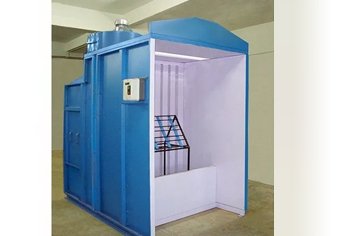
Autocoat lab spray booth — installed at a paint manufacturer's R&D lab in India
A lab booth (also called a lab spray booth) is a compact ventilated enclosure designed for laboratory-scale paint spraying, coating tests, colour matching, and R&D sampling. The lab spray booth captures atomised paint overspray and solvent fumes through downdraft or cross-draft airflow, filters contaminants through paint arrestor and HEPA filters, and protects the operator, product, and environment. Typical lab booth dimensions range from 1×1×1 metre to 2×2×2 metres with airflow of 0.3 to 0.5 metres per second — much smaller than production spray booths, but built to the same core safety standards. The terms lab booth and lab spray booth are used interchangeably in the coatings industry.
⚡ Quick Facts — Lab Booth / Lab Spray Booth
- Also called
- Lab booth, lab spray booth, laboratory spray booth, R&D lab booth, lab paint booth
- Definition
- Compact ventilated enclosure for lab-scale paint sampling & R&D
- Typical size
- 1×1×1 m to 2×2×2 m internal cabin
- Airflow
- 0.3 – 0.5 m/s face velocity
- Filtration
- Paint arrestor + HEPA H13/H14 + activated carbon
- Lab booth price
- ₹2 lakh – ₹12 lakh in India (2026)
- Compliance
- CPCB · OSHA 1910.94 · NFPA 33 · BIS IS 3103
- Main users
- Paint mfg R&D, pharma, aerospace, universities, OEM labs
- Manufacturer
- Autocoat Engineering India — lab booth & lab spray booth maker since 1985, HAL approved
📋 In This Guide
- What Is a Lab Booth / Lab Spray Booth?
- Lab Booth vs Industrial Spray Booth
- How a Lab Spray Booth Works
- 12 Key Features of a Lab Booth
- 8 Applications & Industries
- 4 Types of Lab Spray Booths
- Safety Standards & Compliance
- Lab Booth Price in India
- How to Choose a Lab Spray Booth
- Installation Requirements
- Maintenance Schedule
- FAQs
What Is a Lab Booth / Lab Spray Booth?
A lab booth — also called a lab spray booth, laboratory spray booth, or lab paint booth — is a purpose-built ventilated cabinet where laboratory technicians and R&D engineers safely spray paints, coatings, resins, or adhesives on small components. The two terms describe the same equipment: "lab booth" is the short form, "lab spray booth" is the fully descriptive form. Both refer to a compact, filtered enclosure that captures overspray, filters solvent fumes, and provides a repeatable airflow environment for coating tests.
Where a production spray booth is sized for cars, machinery or large components, a lab spray booth is scaled for samples — test panels, tablets, prototype parts, resin batches, or colour-matching pours. A lab booth runs intermittently for short paint cycles rather than continuously for shift production. See our Autocoat lab spray booth product page for standard sizes and specifications, or the lab booth catalogue for compact R&D units.
Lab Booth vs Industrial Spray Booth
The lab booth and industrial spray booth serve different scales of work. A lab spray booth is optimised for R&D sample sizes; an industrial spray booth is optimised for production throughput. Here's how they compare across 9 key parameters:
| Parameter | Lab Spray Booth | Industrial Spray Booth |
|---|---|---|
| Cabin size | 1×1×1 m to 2×2×2 m | 3×3×3 m to 15×5×5 m or larger |
| Sample weight | Up to 20 kg | Hundreds of kg to tonnes |
| Airflow velocity | 0.3 – 0.5 m/s | 0.4 – 0.6 m/s (waterborne), 0.5 m/s (solvent) |
| Exhaust CFM | 500 – 2,500 CFM | 5,000 – 60,000 CFM |
| Duty cycle | Intermittent, short cycles | Continuous production |
| Filtration | Paint arrestor + HEPA + carbon | Multi-stage industrial filters, water wash optional |
| Typical price (India) | ₹2 lakh – ₹12 lakh | ₹8 lakh – ₹1 crore+ |
| Users | R&D labs, QC, pharma, universities | OEM, contract painters, refinishers |
| Installation | Often plug-and-play, ductless option | Custom foundation, ducting, utilities |
How a Lab Spray Booth Works
Every lab booth works on the same principle: directional airflow + multi-stage filtration. Whether you call it a lab booth or a lab spray booth, the 6-step process is identical:
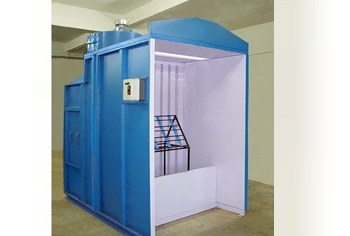
Lab spray booth cutaway — showing directional airflow and multi-stage filter path
- Fresh air intake — Room air enters through the front opening (or a plenum for downdraft models).
- Directional airflow — Air travels across or down through the work zone at 0.3–0.5 m/s, carrying atomised paint droplets and solvent vapours away from the operator.
- Paint arrestor filter — A dry filter (Andreae concertina, cardboard, or fibreglass) traps up to 98% of paint solids.
- Secondary and HEPA filtration — For pharma or hazardous work, a HEPA H13 or H14 filter removes 99.95%+ of remaining fine particles.
- Activated carbon canister — Adsorbs volatile organic compounds (VOCs) and solvent odours. Essential for ductless recirculating models.
- Exhaust or recirculation — Cleaned air is either ducted outside the building or recirculated back into the lab (ductless models only).
12 Key Features of a Lab Booth
When comparing lab booth and lab spray booth models, check these 12 features against your application. The right lab spray booth will match your paint chemistry, sample size, and compliance regime — not just the lowest price.
1. Correct Cabin Size
Internal dimensions must fit your largest sample with 200 mm clearance on each side. Common sizes: 1×1×1 m, 1.2×1.2×1.2 m, 1.5×1.5×1.5 m, 2×2×2 m.
2. Uniform Face Velocity 0.3–0.5 m/s
Air speed at the front opening should be consistent across the entire face. Uneven airflow creates dead zones where fumes accumulate.
3. HEPA H13 or H14 Filtration
Required for pharma, aerospace, and hazardous chemistry. H14 captures 99.995% of 0.3 micron particles.
4. Paint Arrestor Grade F5–F9
Primary filter for atomised paint. Higher grade = longer life but higher pressure drop. Match to paint usage rate.
5. Activated Carbon Canister
Adsorbs solvents and VOCs. Mandatory for ductless models handling solvent-based paints. Replace every 6–12 months.
6. LED Lighting 800–1,200 lux, 5000K
Colour-corrected 5000K daylight bulbs enable accurate colour matching. IP65 sealed fixtures for wet cleaning.
7. Explosion-Proof Electricals
ATEX / IECEx rated switches, motors, and lighting for solvent-based paint work. Prevents ignition of flammable vapours.
8. Manometer / Pressure Gauge
Real-time filter pressure drop reading. Alerts you when filters are clogged and need replacement.
9. Stainless Steel or Powder-Coated Interior
SS 304 for pharma / cleanroom labs, powder-coated MS for general industrial use. Easy to clean, corrosion resistant.
10. Rotating Turntable
Motorised or manual turntable enables 360° spraying of samples without repositioning. Improves finish consistency.
11. Front Sash Safety Interlock
Auto-shutoff if front sash / door is opened during operation. NFPA 33 requirement.
12. VOC Monitor
Continuous VOC monitoring for CPCB compliance and operator safety. Alarms if VOC exceeds 25% of LEL.
8 Applications & Industries Using Lab Booths
The lab booth is used across a wide range of R&D, QC, and small-batch production applications. Below are the 8 industries where lab spray booth demand is strongest in India:
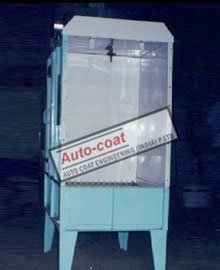
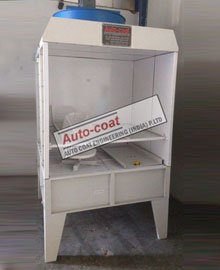
1. Paint Manufacturer Colour Matching & Batch Testing
Asian Paints, Berger, Kansai Nerolac, and Nippon Paint use lab spray booths to spray test panels, verify colour codes, and validate new formulations before scaling to production.
2. Pharmaceutical R&D — Tablet & Capsule Coating Trials
Sun Pharma, Cipla, Dr Reddy's, and Torrent use lab spray booths for coating pilot batches of tablets, capsules, and medical devices with HEPA H14 filtration to meet cGMP requirements.
3. Aerospace & Defence Prototype Coating
HAL, DRDO, BEL, and Bharat Dynamics run prototype coating trials for aircraft parts, missile components, and defence electronics in lab booths — bridging the gap between formulation and production.
4. Automotive OEM Panel Testing
Tata Motors, Mahindra, Bajaj, and Hero MotoCorp use lab booths for prototype panel spraying, weathering test coupons, and durability sample preparation.
5. Chemical & Resin Sampling
Huntsman, BASF India, and Dow use lab spray booths for sampling resins, adhesives, gel coats, and specialty chemicals — the Autocoat lab spray booth was originally developed for Huntsman's resin sampling operation.
6. University & IIT Research Labs
Coating research, nanocoating trials, corrosion studies, and student training programmes require compact, safe, well-ventilated spray booths.
7. Electronics & PCB Conformal Coating
Small-batch conformal coating of printed circuit boards, connectors, and sensor housings using acrylic, urethane, or silicone conformal coatings.
8. Art Restoration, Museum Conservation, Forensic Labs
Sensitive restoration work, museum artifact conservation, and forensic evidence handling require low-airflow, contamination-controlled spray environments.
4 Types of Lab Spray Booths
Not every lab booth is the same. The right lab spray booth depends on your paint chemistry, ducting options, and finish-quality target. Autocoat manufactures all 4 lab booth types described below.
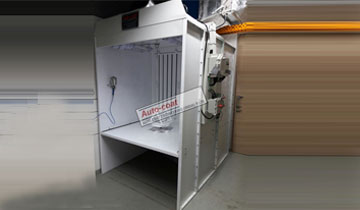
1. Ductless Recirculating Lab Booth
Self-contained with activated carbon + HEPA. No external ducting needed. Fastest installation.
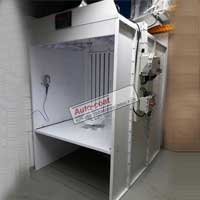
2. Cross-Draft Lab Booth
Horizontal airflow front-to-back, exhaust ducted outside. Most versatile, widely deployed.
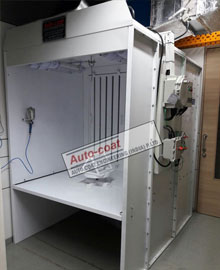
3. Micro Downdraft Lab Booth
Ceiling-to-floor airflow. Highest finish quality, minimal dust — like a mini downdraft paint booth.
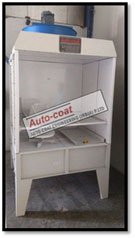
4. Water-Wash Lab Booth
Overspray captured in water tank. Handles heavy paint usage in pilot plants.
Safety Standards & Compliance
Lab spray booths in India must comply with multiple overlapping standards. Autocoat lab booths are engineered to meet all six:
Central Pollution Control Board 2026 norms for VOC emissions, paint arrestor efficiency, and stack monitoring.
Bureau of Indian Standards — industrial ventilation, air velocity, filter classification.
US National Fire Protection Association — Standard for Spray Application Using Flammable or Combustible Materials.
US Occupational Safety & Health — permissible exposure limits, ventilation requirements for spray finishing.
India — workplace safety, machinery guarding, employee welfare, chief inspector approvals.
Cleanroom classification for pharma applications — HEPA H14 filtration + laminar flow required.
Lab Booth Price in India (2026) — Lab Spray Booth Cost by Type
Lab booth price in India varies with type, size, and filtration level. Below is the current lab spray booth price range for the 4 main configurations in 2026, plus common add-ons:
| Booth type | Typical size | Price range (INR) | Best for |
|---|---|---|---|
| Ductless recirculating | 1×1×1 m | ₹2 lakh – ₹4 lakh | Water-based R&D, pharma sampling |
| Cross-draft lab booth | 1.2×1.2×1.2 m | ₹3.5 lakh – ₹6 lakh | General R&D, colour matching |
| Micro downdraft | 1.5×1.5×1.5 m | ₹5 lakh – ₹9 lakh | Aerospace prototype, OEM QC |
| Water-wash lab | 2×2×2 m | ₹6 lakh – ₹12 lakh | Pilot-scale production R&D |
| Add: HEPA H14 upgrade | — | + ₹40,000 – ₹1.2 lakh | Pharma / hazardous work |
| Add: Activated carbon | — | + ₹25,000 – ₹80,000 | Solvent VOC control |
| Add: PLC + VOC monitor | — | + ₹60,000 – ₹2 lakh | Compliance & automation |
See full paint booth price in India guide for industrial-scale pricing.
How to Choose the Right Lab Booth / Lab Spray Booth (7-Step Checklist)
Choosing a lab spray booth is a matter of matching cabin size to sample, chemistry to filtration, and airflow to compliance. Follow this 7-step lab booth buying checklist:
✅ Lab Booth Buying Checklist
- Define largest sample size — measure biggest workpiece + 200 mm clearance each side
- List paint chemistry — waterborne / solvent / isocyanate / epoxy determines filter type & ducted vs ductless
- Calculate airflow — target 0.3–0.5 m/s face velocity × opening area = required exhaust CFM
- Choose booth type — cross-draft (most R&D), downdraft (highest finish), water-wash (heavy paint), ductless (water-based only)
- Specify safety — explosion-proof electricals, VOC monitor, sash interlock, HEPA H14 for pharma
- Verify compliance — CPCB, OSHA 1910.94, NFPA 33, BIS IS 3103 certificates from manufacturer
- Request quote + site visit — itemised BOM, 1-year warranty, utility survey (power / exhaust / floor)
Installation Requirements
- Floor space — cabin footprint + 800 mm operator clearance in front + 400 mm service clearance behind
- Electrical supply — 3-phase 415V typical, single-phase 230V for compact ductless models
- Ducting — 200–400 mm dia MS or SS pipe to rooftop for exhausted models; ductless needs none
- Compressed air — 6–8 bar, oil-free, 100–200 LPM depending on spray gun
- Fresh air makeup — provide equivalent volume of tempered fresh air into the lab room
- Fire suppression — CO2 or clean-agent system for solvent-based paint work
- Consent to Operate — obtain from State Pollution Control Board before commissioning
Maintenance Schedule
| Task | Frequency | Notes |
|---|---|---|
| Paint arrestor filter change | Every 40–120 hrs | Or when pressure drop > 250 Pa |
| Pre-filter change | Every 200–400 hrs | Extends HEPA life |
| HEPA H13/H14 change | Every 12–24 months | Or when pressure drop doubles from clean value |
| Activated carbon change | Every 6–12 months | Or when solvent odour is detected |
| Manometer check | Weekly | Log readings for trend analysis |
| Fan bearing lubrication | Quarterly | Grease per manufacturer spec |
| Booth interior cleaning | Daily | Wipe with tack cloth |
| Airflow measurement | Monthly | Anemometer at booth face |
| VOC sensor calibration | Annually | By certified technician |
| Full preventive maintenance | Annually | Recommended for warranty compliance |
Bottom Line
A lab booth (lab spray booth) is the small-scale, high-precision cousin of an industrial spray booth — built for R&D, colour matching, and pilot batches rather than production. The right lab spray booth depends on 3 things: what you spray (chemistry), how much you spray (volume), and what compliance regime you sit under (CPCB, pharma cGMP, aerospace HAL). Autocoat Engineering has manufactured lab booths and lab spray booths for Huntsman, HAL, DRDO, Sun Pharma, Asian Paints and dozens of IITs since 1985 — get in touch for a specification-matched quote.
Get a Lab Booth / Lab Spray Booth Quote in 24 Hours
Custom sizing · CPCB compliant · HEPA H14 optional · Pan-India installation · 1-year warranty · Lab booth price from ₹2 lakh
Request Free Lab Booth Quote → See Lab Spray Booth Specs